

THE FLOWER CAROL
June, Jean Ritchie, a medieval carol, and the work of being formed

Seasonal and communal songs have long belonged to every culture. Liturgically, yes, but also in the fields, at work, in joy, and in lament. The human experience has always found its way into song. A tune has long life in the head and heart. They are carried, retaught, and remembered. This the power of verse and song.
The Still Room1 is naturally a place of curiosity, carol, curation, cutting, and curing. No season holds exactly the same as the last. And yet formation occurs within both the familiarity of the season’s return and the newness of its arrival.
Seasonal formation is simply this: allowing the season you are in to teach you how to pray, work, rest, notice, tend, feast, fast, and become. We are constantly being formed. By our schedules, our desires, our habits, our beliefs, our wrongdoings, and eventually, these things form us into who we are. The body, mind and spirit keeps score of what we repeatedly give it: hurry, noise, envy, resentment, distraction, prayer, silence, work, song, bread, grief, rest. Where do these things lead us? We can go as willing participants, disillusioned or distracted, even as captives. But they all beg the question — what does it mean to be human, fully alive in this minute, hour, season?
We can give ourselves to the formation of Christ, or we can allow something else entirely to form us. Two realities. Humankind has a long and dark history of being formed away from the heart of its Maker. This is part of what makes the Still Room so powerful. Seasonal formation, akin to spiritual formation, particularly formation in the Way of Jesus, gives us a place to hold both: the prayers of last June and the prayers of this one. The griefs and gifts that return, and the ones we could not have anticipated.
As we cannot live all the seasons at once, we cannot be formed by all the seasons at once. Not those to come, nor those behind us. Today is what we have. Today is what we have been given, within this season. If the Way of Jesus is new to you, it is a way of orienting your life and teachings of Jesus, and doing what he did, by whom all things are held together. In Him we find why the seasons matter at all, and why living in tandem with Creation, community, and Creator carries true power.
It is also why the Still Room exists.
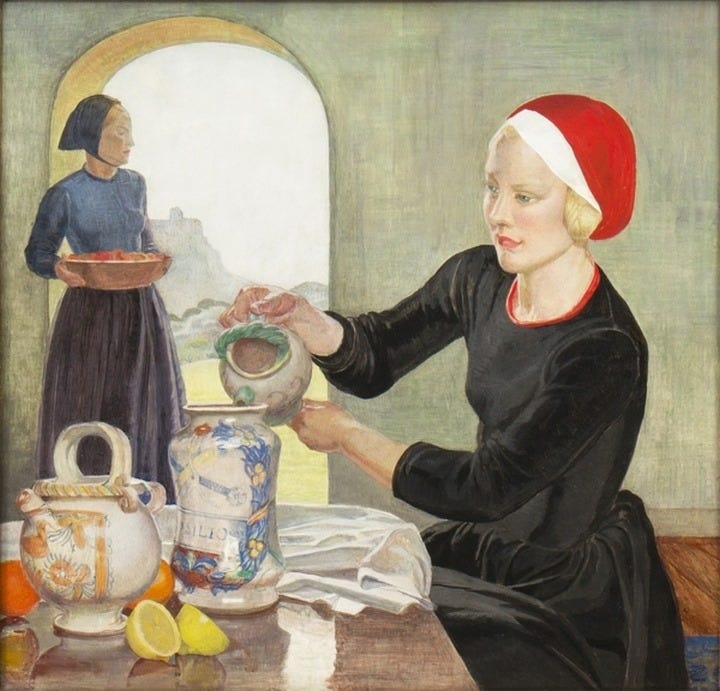
It’s an older place where woman captured the bounty of the season and prepared wisely for the next. I have found it all that and and more. A place to wrestle with God, with what the seasons bring, and with your my place in it all. A counter-cultural resistance takes place here. A sitting with life. An examination of self, skill, faith, and season. A leave-taking of the hurried, frantic, selfish, and fleeting life, and a turning toward something deeper, the call from darkness into light.
The Still Room is not merely a place to learn a skill or gather information. It is a place to be formed. By the work of your hands, by the turning of the year, by the company you keep, by the stories you inherit, and ultimately by Christ Himself. One season making way for another, one prayer making way for the next, one faithful day at a time.
Depending on the tradition you come from, or the baggage you carry, this can be scary. It is easier to be busy. Easier to consume and buy, to push our families to perform and achieve, to fill the silence and the need for rest with more. Control is a yoke placed on our shoulders under false pretenses, promising that I can make my load easier if only I call the shots and keep everything moving. The enemy of the soul too is a cruel master, yanking heads to and fro, a whip behind with a heavy load and long hours with no rest and sustenance.
But there is another song here: “Come to me, all who labor and are heavy laden, and I will give you rest. Take my yoke upon you, and learn from me, for I am gentle and lowly in heart, and you will find rest for your souls. For my yoke is easy, and my burden is light.”2
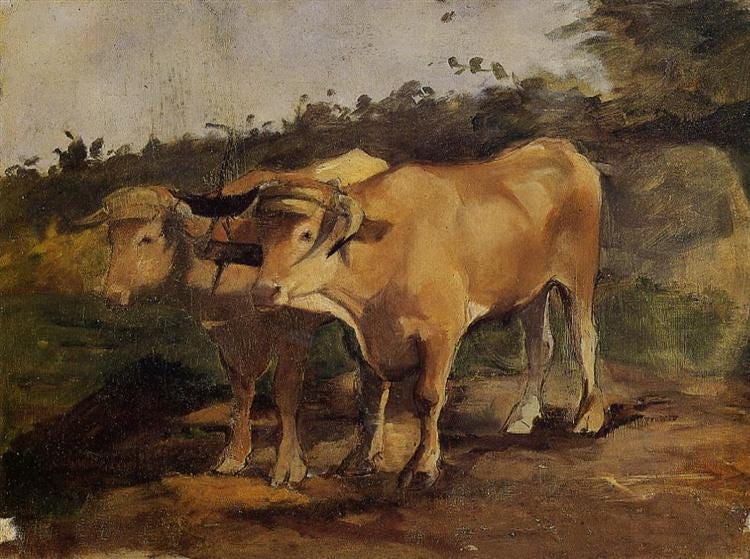
But how? By living this day in prayer and openness, willing to be guided and taught. A yoke is a thing of work. A wooden bar fastened to a beast of burden so it can pull with another. And there is work here, in this season, both unseen and tangible. But think of the load we bear when there is no one else pulling with us. The Maker of your body and soul says, 'in this season, ‘take my yoke and learn from me. For I am gentle and kind, and I will be with with you, because it is my yoke too.’
Formed by the Season - A Few Favorite Resources
There’s still work to be done. There’s steps to take and decisions to make. That is why I have found the cues of the month and season so helpful and beautiful. I could go on and on, and this list is no where near exhaustive but these are good places to begin, and begin again.
REST: First, I start in rest. A 24 hours rest. Saturday night to Sunday night every week is a day of delight, prayer community. Work is aside and technology too. This is a spiritual discipline and arguably one that holds the key to many others. Practicing the Way has done excellent work on formation and discipleship.
PRAYER: morning, noon, eveningtide. Set a a gentle alarm. If you don’t know what to pray, I like the app Lectio 365 and Every Moment Holy from Rabbit Room Press.
AN EYE ON THE LITURGICAL CALENDAR: For beginning exploring the Liturgical Calendar. I love Danielle Hitchens Sacred Seasons. For a more in depth look — Friend Kristin writes and is the artist at Hearthstone Fables.
SEASONAL RHYTHMS: This cannot be copied from another. Part of it is learned, part of it is found. It is the heartbeat of your home that forms you and those within. It is informed by all of the above, and more — for there are many beautiful ways to be formed. They are reveled in the days, seasons, the Spirit of God, a friend.
I will leave you with this:
“He has contrived to gratify both tastes together on the very world He has made, by that union of change and permanence which we call Rhythm. He gives them the seasons, each season different yet every year the same, so that spring is always felt as a novelty yet always as the recurrence of an immemorial theme. He gives them in His Church a spiritual ear; they change from a fast to a feast, but it is the same feast as before.”
C.S. Lewis, The Screwtape Letters
A Song for this Season
Jean Ritchie remains one of the great examples of how songs are carried through time. Raised among the Singing Ritchies of Kentucky, she inherited a repertoire of ballads passed from generation to generation, by memory, voice, and hearth. Many of these songs can be traced to English, Scottish, and Irish traditions brought to Appalachia by settlers centuries before. Some were recognized by folklorists as descendants of the Child Ballads, preserving stories, melodies, and turns of phrase that had survived remarkably intact through hundreds of years of retelling.

A few mornings ago I found myself listening to Jean Ritchie's Flower Carol while writing and researching. It felt strangely out of season, but the latin (now english) lyrics are perfecting in. The song itself is far older than Appalachia, older than America, older even than the Reformation. Its roots reach into a medieval Latin spring song, original Latin from the Swedish Piae Cantiones, preserved in a collection printed in1582 — Tempus adest floridum—"the flowering time is here". For centuries its melody belonged not to Christmas but to spring and early summer. Before it carried Good King Wenceslas through the snow, it carried flowers through the fields. Like many songs carried across centuries, the words may be changed slightly, but the central theme remained: as the world is renewed, we too are invited into renewal. That is the power of seasonal song, and I hope this becomes a favorite of yours.
And so the song goes:
THE FLOWER CAROL
Original Latin from the Swedish Piae Cantiones, 1582 translated to English for the Oxford Book of Carols in 1928
Spring has now unwrapped the flowers,
Day is fast reviving.
Life in all her growing powers,
Towards the light is striving.
Gone the iron touch of cold,
Winter time and frost time,
Seedlings working through the mould,
Now make up for lost time.
Herb and plant that, winter long,
Slumbered at their leisure,
Now bestirring, green and strong,
Find in growth their pleasure:
All the world with beauty fills,
Gold the green enhancing;
Flowers make glee among the hills
And set the meadows dancing.
Earth puts on her dress of glee;
Flowers and grasses hide her;
We go forth in charity–
Brothers all beside her;
For as man this glory sees
In the awakening season,
Reason learns the heart’s decrees,
And hearts are led by reason.
Praise the maker all ye saints,
He with glory gird you,
He’s who skies and meadows paint,
Fashioned all your virtue,
Praise him seers, heroes, kings,
Heralds of perfection,
Brothers praise him for he brings,
All to resurrection.
or found another way:
Through each wonder of fair days
God Himself expresses
Beauty follows all her ways
As the world she blesses;
So as she renews the earth,
Artist without rival,
In the grace of glad new birth
We must seek revival.
A June Happening
I found myself unexpectedly moved to learn that The Local Wild has been included in the Smithsonian Folklife Festival Marketplace as part of the 250th anniversary of America.
A story alongside countless others, honey is as abundance as songs in the history humankind. And like songs survive when someone sings them, skills survive when someone practices them. Traditions survive when someone receives them and passes them on, at places like the Still Room. A medieval spring carol found its way to the voice of Jean Ritchie. Old remedies found their way into a still room shelf. The work and tune continues and the thread remains. One season makes way for another. One generation teaches the next. We receive, we tend, and we pass along what has been given.
Thanks for joining me at the Still Room, living the seasons together and keeping The Local Wild Remedies on your shelf.
Matthew 11:28-30