

A Winter Door
On Thresholds, Feasting, and the Turning of the Year

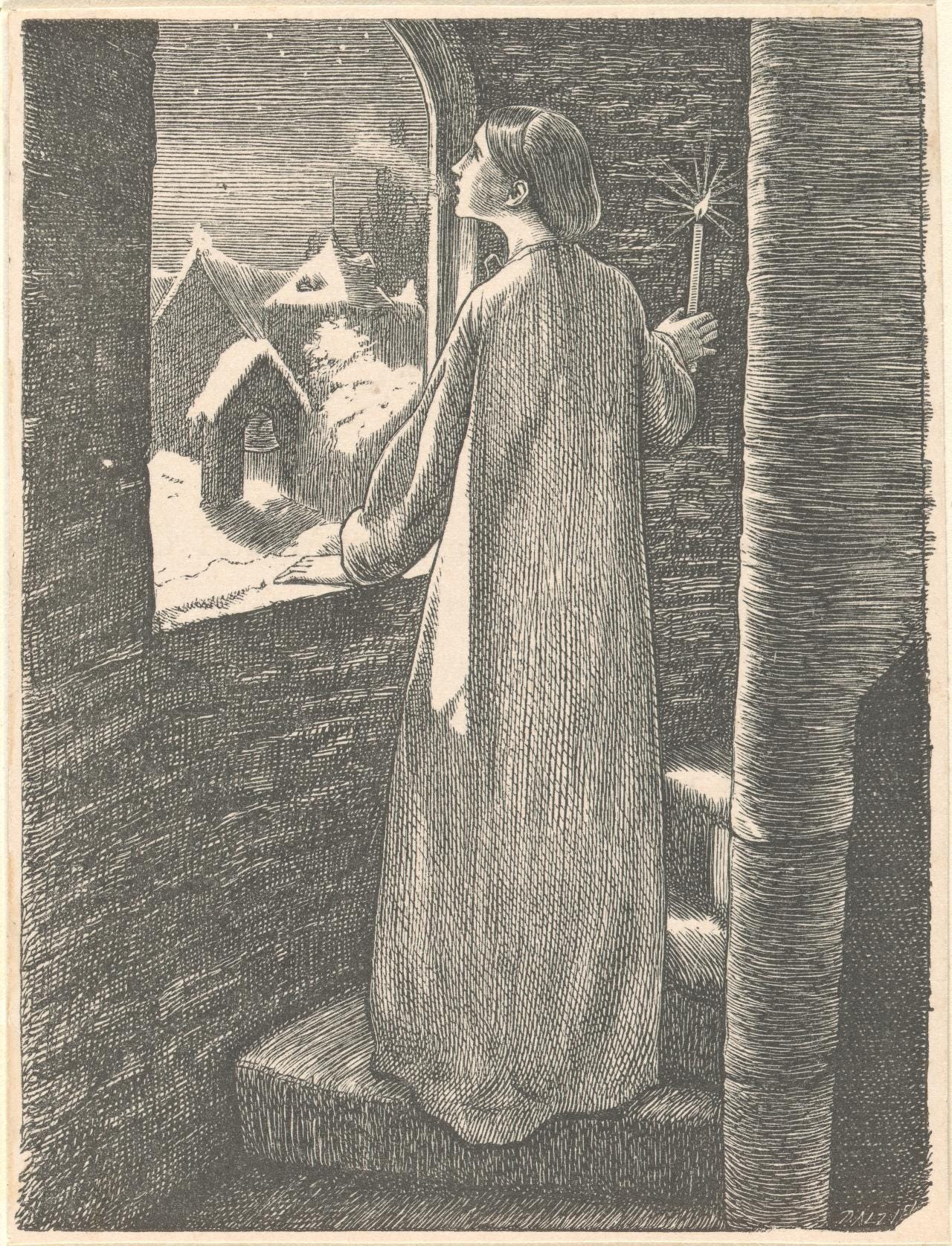
A box of chalk lies on the table as I pull on my wool coat. I’m leaving behind the warm radiance of the wood stove and the giggles of children to bed, settling. A mid-night walk begs me through the door. I pass under the old frame — a threshold to older things. I softly shut the door, into the dark with only the first full moon to lend its light to the fallow fields. Just enough, so that the branches and crooks of trees reach toward me, sending their shadows where there should be none. Eyes glow at the edge of the field. Hungry cloven hooves paw at frozen earth for a bit of grass, a root. This is not the time of plenty for the creatures of the forest and fields. Jovial and joyous indoors; cutthroat and cold outdoors. In the distance, the coughing bark of a fox, preceded by the squeal of a rabbit dying. Two different realms, parted by an old door.
Inside, the tree is still adorned. Christmas books and crafts lie strewn about. The days have been filled with extra food, drink and leftovers — a great pause from all the rigor and rigmarole with which we fill our days: the goings and wakings and flitting from this and that. Eat and drink! for tomorrow is school and work and chores. But for a few days — these last precious few — I glimpse, as if through the whorl of old glass, perhaps the dim foretelling of a great feast to come, one that will never end.
But time beckons, and I its ward. It says all things must end. Christmas and its twelve days are soon spent. Ritual is the bodies way of remembering, so we will bring out the white flour for a cake on the morning of the twelfth day, white chalk for the door too. And so the twelfth, all feasting ends here in this place. Perhaps ends is the wrong word — completed, rather. Like leaving a long-loved place or book: it is done now, and you must close the page and put it back on the shelf. It can only be remembered, never relived or read for the first time. That kind of completion.
I feel the pang of Christmastide ebbing, slipping — like two places blending: harsh cold and warm den, fast and feast, familiar and unknown. I passed through and am changed, even if breadth not wholly known yet. I know that I am fed and glad and ready to wander from this place.
I pass through the threshold, looking warmly on the time I spent in it’s embrace, how it formed me — how I will remember it. A Christmastide to my name, and now I go to gather another winter too, walking into the frozen fangs and sharp claws of this waning winter moon.
For the Still Room
For the turn of Christmastide, I invite you to sit at your Still Room with me, and deeply feel the time of feast soon gone, winter now here. I keep a Still Book — either a binder with pages to insert, a journal for keeping and writing. This can and should be passed to those coming after as a way of remembering the seasons and the ways they form.
The practices help embody the season and form the rhythms of faith in following the Way of Jesus. We remember these promises with our whole body out of love for our Lord — with all our body, soul, mind, and strength. They are not tests of faithfulness or holiness, but reminders of truth to be done in grace, freedom and in celebration.
Here are older ways households once noticed time passing, and chose to go with it attentively. In doing so, we join those before and teach those who will come after.
As a rule in the Still Room:
Keep what you can.
Leave what you can’t for another season.
Record what you remember, and how you and yours make it your own.
Remember, every season is different. You cannot live all the seasons, nor can you repeat on that has happened before. So come to this one now and know it intimately, for it is yours.
That is the work of the Still Room.
Twelfth Night & Epiphany: A Brief History
The Twelve Days of Christmas emerged in late antiquity, particularly the fourth and fifth centuries, as Church tradition began to hold Christmas (December 25) and Epiphany (January 6) together as a single season. By the early medieval period, Epiphany functioned as the season’s completion, when feasting gave way to ordinary time. In many households, Christmastide ended quietly: greenery was taken down, a final meal was shared, and daily work resumed.
The Twelfth Day of Christmas arrives on January 6, with its eve kept the night before, January 5. Traditionally, this marked the completion of Christmastide — a turning, an ending.
The Twelve Days of Christmas teach us how to feast and dwell in the joy and mystery of the Incarnation — the Creator stepping into His creation, God and man. And with this, faith: that small spark which sets a life ablaze, from death to life.
Epiphany remembers the Magi — learned men from the East who followed a sign written in the heavens and knelt before Christ as King. Their journey remains a wonder: creation bearing witness, wisdom bowing low. Their arrival marks the moment when the joy of Christmas is no longer held close within the nation of Israel, but revealed outward for all people, good news for all nations!
A Final Cake
In many parts of England and Europe, Christmastide ended with a Twelfth Cake, King’s Cake or Epiphany bread — rich, sweet, shared. Sometimes something was hidden within — a bean, or pea or small token and whoever found it was king or queen for the day!
The feast must end but first! A last richness, the final sweetness, offered, shared and gladly held in the culmination of the season.
If you keep this tradition:
Bake or serve something already at hand
Let it be eaten with remembrance, closure and joy. Share memories of the days past, talk about winter plans and hopes.
Clear the table afterward, let the season be done. Notice the weight, sadness, reluctance, relief of the season — remember this in prayer.
Have friends over for dinner, cake with a crown at the ready!
The point is not excess, but the culmination of enough. We cannot live all our days in feast, but we can take the promise with us.
2. Marking the Door
In some older Christian households, doors were marked on Twelfth Night or Epiphany with chalk — a quiet act of blessing and remembrance.
The marks often took this form (with the current year):
20 ✶ C ✶ M ✶ B ✶ 26
from the Latin Christus Mansionem Benedicat — May Christ bless this dwelling and later the ascribed names from church tradition as the initials of the Magi (Caspar, Melchior, Balthasar)
Chalk is humble, temporary, easily erased. It was not protection by force, will or a charm.
If you keep this tradition:
mark a doorframe passageway with 20 ✶ C ✶ M ✶ B ✶ 26
pray for the winter and “Ordinary Time” to come
Have children make their own small marks
Remember and memorize the Shema — Long before Christian households marked their doors at Epiphany, Israel was commanded to bind love of God to the threshold itself — to write the words of the Shema on the doorposts of the home, so that faith would be remembered in the passing.
Hear, O Israel: The Lord our God, the Lord is one. You shall love the Lord your God with all your heart and with all your soul and with all your might.
And these words that I command you today shall be on your heart.
You shall teach them diligently to your children, and shall talk of them when you sit in your house, and when you walk by the way, and when you lie down, and when you rise. You shall bind them as a sign on your hand, and they shall be as frontlets between your eyes. You shall write them on the doorposts of your house and on your gates.
Deuteronomy 6:4-9
3. Clearing the House
Twelfth Night was often the time when greenery came down, decorations were put away, ordinary work resumed. Not in haste, but with intention. This clearing also marks the return to Ordinary Time — the season where most of life unfolds in the Church Calendar and the Natural world. The feast has formed us, nourished us; now its meaning is lived out in work, in winter, and in the long patience of ordinary days.
It is return.
A good time for projects, cleaning, organization, handiwork and tending. Note: it’s not the time for newness, growth change. Take cues from your nature too — a deep rest is settling, unseen work deep in the roots.
If you have not done so, A Still Room or Nook would be a welcome addition to keeping memory, projects, remedies and stories in your home. We will be looking rather extensively at The Still Room this year!
Dream and pray on the home you are creating and nourishing — as a light and place of safety in these darker days.
4. Entering Ordinary Time
After the Twelfth Day, we move into what is called Ordinary Time in the Liturgical year — not because it is unimportant, but because it is where life is lived, numbered and spent.
This is where:
bread is baked again
nights are long, rest is offered
tools are taken up
school and ongoing learning is resumed
routine and spiritual rhythms are kept
fields lie fallow
winter is faced honestly
The feast has formed us. Now we walk it’s threshold, onward.
I simply adore your writing. It embraces me like a knowing hug, giving light and language to deep stirrings previously unrealized.
This post is an excellent guide for all who are like minded and have found your voice.
Thank you for being out there, fulfilling your purpose and helping others along the way.